The "Panic Payment" Insight
Many customers receive loans to cover their daily needs. When they apply for a new loan, there is a hard check conducted by the bank to decide, first of all, the trustworthiness of the customer and, secondly, the terms and conditions of granting the loan.
When a loan is approved, a payment plan is created, and the customer knows exactly how and when he/she will pay, depending on their financial needs.
For example, the bank estimates and calculates the customer’s cost of living and other spending activities, so the customer can be consistent with their payments.
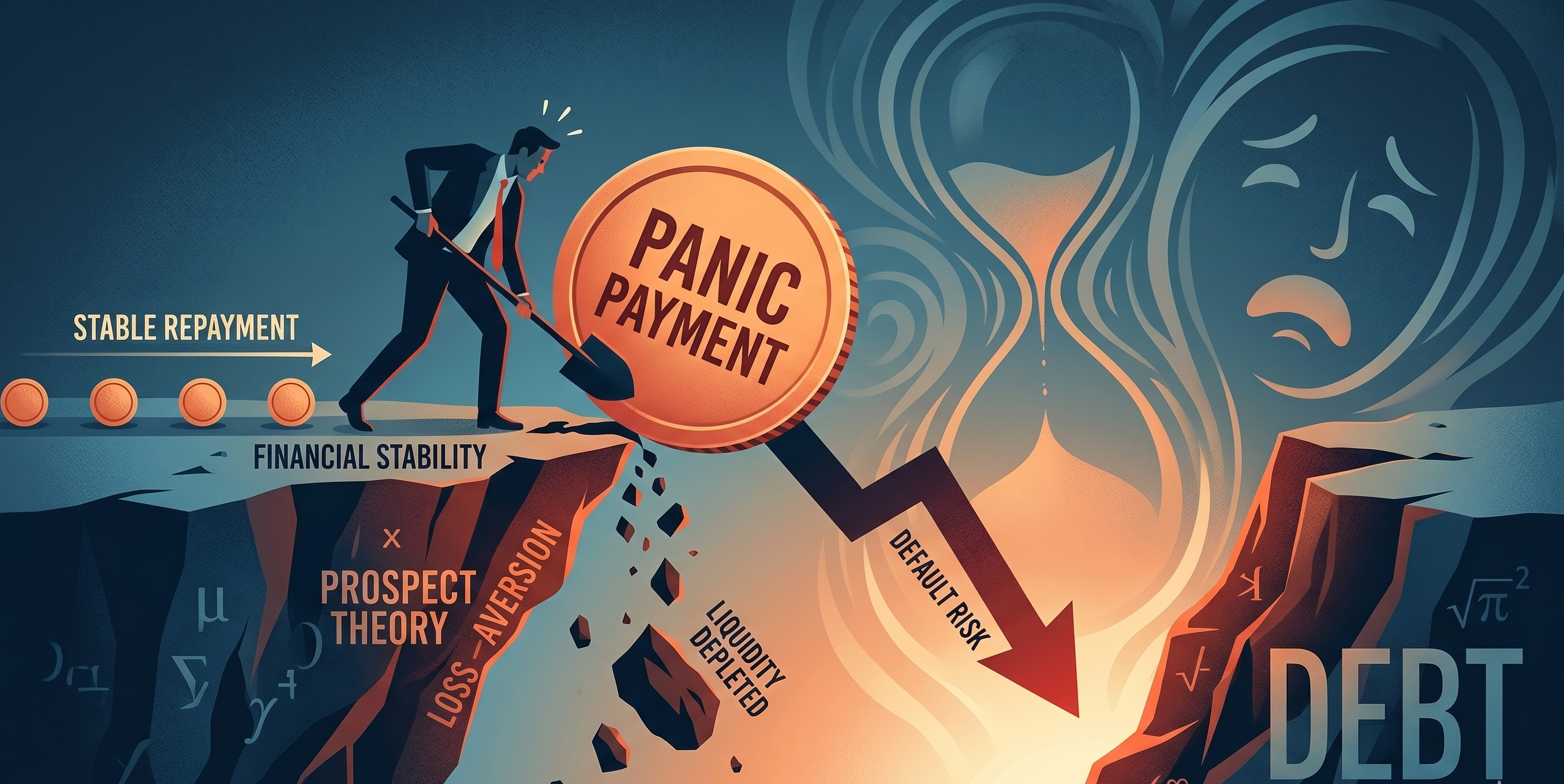
However, there is a portion of customers who are anxious and try to prepay a larger part of their loan. By ignoring the loan's policy and paying larger amounts than agreed upon in order to eliminate their debt, they often achieve the opposite of their intention.
They reduce their available funds to the point where, sometimes, they cannot cover their daily needs.
This kind of behavior can be characterized as 'panic payment' and was observed in 0.22% of the Taiwan Dataset.
It can be interpreted through Kahneman and Tversky’s (1979) Prospect Theory and the concept of Loss Aversion. According to this theory, the psychological impact of a loss, such as a credit default, is significantly more intense than the satisfaction of an equivalent gain.
Consequently, distressed borrowers make desperate large payments, depleting their last liquidity reserves to delay an inevitable default, even if it remains statistically certain for the following month.
This proves that consistency over time is the real indicator of creditworthiness, rather than just the size of a single payment.
This is an effect of everyday life; because borrowers want to remove the obligation of debt, they pull ahead of their original plan.
By paying more, they end up with an inability to keep their financial behavior stable, making their payment plan fragile and their creditworthiness unsafe.