People as Datasets : Can a Cell Contain a Soul?
How many times have you found yourself staring at the ceiling at night, with a bitter feeling that all your worries, all your anxieties and dreams, might fit into a few bare numbers? I often wonder: what does it mean to be human in an age when your worth and voice are measured in rows and columns, in cold files that classify your existence? Can an ID imprison the uniqueness of a life, the struggle, the trembling breath before you hit “submit” on yet another application?
In every project I undertake, I feel as if I hold in my hands not just data, but captured breaths, glances, and silences of people. An entire library of shadows and desires, folded neatly inside tables. Each ID is a separate world, an ocean of experience, but the screen shows only small, forgotten numbers.
Ιn my Postgraduate thesis, the databases I used becomes a mirror of society: two million distinct voices recorded silently, clearly, but also so invisibly. Rents that drown hopes, bills that erase dreams, files with cold sums, insurances and all together they weave the net of daily struggle, insecurity, and even hope.
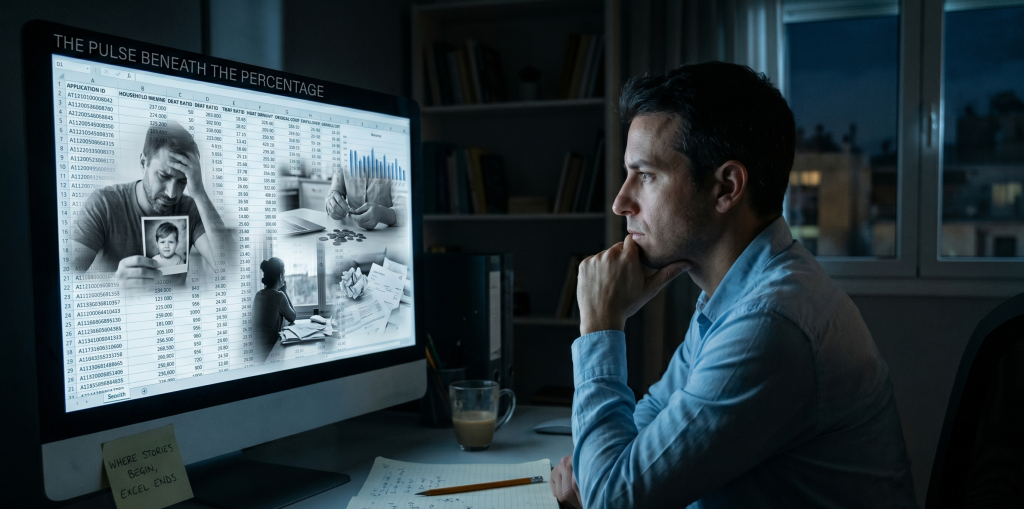
Perhaps the most painful part is when a person turns into a “trend,” a mark on a chart, a probability. Behind the mathematical precision, life is often forgotten. The numbers are fair, says the system. But I see what they hide: I see the gaze that avoids the morning light because it brings new bills, I see the hands counting and recounting coins on the kitchen table before deciding whether to pay the electricity or the installment.
Thousands of anxious hours pile up behind those “entries.” Pencils are worn down, papers are crumpled; calculations carry anxiety, hope, tenderness, endurance. Empathy cannot be written into cells and I tried to see it behind every percentage.
I remember the sorrow, perhaps even the anger I felt looking at those records; there I focused on a father. I never met him, but I read his application: he was asking for a small loan, as much as gifts and wishes for his son who needed surgery. If the loan was approved, it could change the child’s life, give him the ordinary gift: to walk. Where the system saw risk, I saw a father, his gaze fixed on his child’s photo, his heart growing heavy with every word he typed in the application.
I then realized: no dataset can contain pain, joy, worry, courage. The gaze of the bank officer scanning the data may carry a nearly tragic responsibility: to decide lives based on cold, standardized variables.
The perfection of models, is vulnerable when faced with the depth of human fate. Where stories begin, Excel ends. Perhaps this is the truth that those who research, calculate, and decide must remember: that humans have depths far beyond what even the most advanced database can measure. Because numbers reveal the surface. But the soul and hope always lie beneath.